Showing posts with label HACC. Show all posts

Friday, June 5, 2020

Coronavirus Updates 6/5


It was announced that the daily flyer / announcement updates (see 6/3 informational flyer here) will become a weekly update on Wednesdays. The website will still have daily updated coronavirus information here. Public testing sites like the one at Marketplace Mall will also be open to everyone now, regardless of whether they have symptoms or other factor. WAND had more on the opening of testing to all here.

There was a meeting of the Joint Information Center with some questions from the media after the local updates from C-U Public Health District administrator Julie Pryde and City of Champaign Mayor Deb Feinen. The video of that meeting is available here. Previous videos are available at the C-UPHD website at this link and under the heading "Champaign County Joint Information Center Public Outreach Videos" near the bottom of the page.

A highlight from the questions was an explanation about people who attended the protests and the need to get tested. Administrator Pryde explained how long one should wait to get tested after a possible exposure. The way this infection takes hold and the way PCR tests work, at least 4 days is probably good to avoid a higher chance of a false negative. She reminded listeners that the testing is a tool, not a certainty, however. She encouraged vigilance and safe distancing as in some cases it can take longer (e.g. 14 days).

Mayor Feinen explained her latest Executive Order and how it expanded additional hours for private spaces that would apply to certain businesses. The City is looking to expand outdoor seating options next week. While Urbana is adding some more public music options this week, that's something Champaign isn't doing yet, but also considering.

WAND had an article with an overview of the changes from the State's Phase 2 to Phase 3 with a lot of additional details here. A snippet with a basic overview of Phase 2 and Phase 3 from the public chart:

 
WCCU had an article yesterday specifically looking at Phase 3 guidance for Illinois schools and the very different setting kids will be entering when they return to classes. There was a link to the full guidance from the Illinois State Board of Education here.

The News-Gazette's latest update today suggests signs that we could be moving to phase 4 in the central region if outbreaks and cases can be kept under control and within our regional hospital capacities:
To advance to Phase 4 of Gov. J.B. Pritzker’s five-phase Restore Illinois plan three weeks from now, regions will have to hit the same metrics that they did to move on to Phase 3 last week.

So far, so good for the central region, which includes Champaign, Douglas, Ford, Piatt and Vermilion counties.
More on that at the full article with today's Champaign County updated numbers (including 4 new cases for a cumulative total of 675). WCCU had a brief overview of the County numbers today here. More data from the C-UPHD website here.

I missed the June 1st Board of Health special meeting and update mentioned in my last coronavirus update that covered the previous May meeting. I don't have any additional details on that yet.


A few other recent highlights:

Smile Politely had a quick blurb about a COVID-19 Relief Fund grant and a link to additional information here.

WCIA had an article about the Housing Authority of Champaign County's Youthbuild program providing care packages to seniors as part of COVID-19 assistance.

Unit 4's summer food program is still going on this summer. More details on that from WCIA here.

Sunday, February 16, 2020

City of Champaign Updates


This post covers the most recent Study Session topics on ordinance violation fines and the five year housing and community development plan for federal funds.It also covers some other updates and news items related to the City of Champaign (jump to link) on topics such as the Planning Commissions's recent recommendations, a damaged traffic light by an uninsured driver, and an update on the City's Southwest Master Plan for development around Curtis Road and the I-57 interchange.

The City of Champaign looked at reducing its fines for ordinance violations at its last study session. The video of the study session report on ordinance violations had a helpful explanation of how ordinance violations work. They explain the rationale behind them, how they're enforced, the state laws guiding local municipalities, and an overview and history of the fine levels in Champaign. That video is available here. The written report is available here. The News-Gazette had coverage earlier this week:
The city puts certain alcohol-related ordinance violations, such as underage drinking and using a fake ID, in its highest tier of offenses, for which the fine is $350.

At this week’s city council meeting, several council members said those fines are too high and instructed staff to adjust them for consideration at a future meeting...

In fiscal 2019, the city collected $635,971 in fines, which staff noted is less than 1 percent of the city’s general revenue fund. “Champaign does not use fines as a significant source of revenue to make up the City budget,” staff wrote in a report to council.
More at the full article here. Also covered at the study session was a five your plan relating to affordable housing priorities and related funding. Basically the City has to explain how it plans to use funds towards housing issues related to grants and programs for housing and community development. Excerpt from the written report:
The Five-Year Consolidated Plan and associated Annual Action Plans serve as the application for the Community Development Block Grant (CDBG) and HOME Investment Partnership Program (HOME) funding through the U.S. Department of Housing and Urban Development (HUD).

High priorities from the previous (2015-2019) Consolidated Plan were to provide affordable housing, eliminate slum/blight and support public services. Significant progress was made towards these goals with the completion of housing rehabilitation to 225 households, the near completion of the Bristol Place Redevelopment and the public services support to youth in the CommUnity Matters program.

The development of the new 2020-2024 Five-Year Consolidated Plan includes active collaboration with Champaign County, the City of Urbana, the Housing Authority of Champaign County, CU Public Health District and the Champaign County Continuum of Service Providers to the Homeless...

Recommended housing priority areas for the 2020-2024 Consolidated Plan are: owner occupied rehabilitation and weatherization, affordable rental housing opportunities, homelessness support and reduction of lead-based paint exposure.

Recommended community development priority areas for the 2020-2024 Consolidated Plan are: public services for youth and special populations, public facilities and infrastructure improvements and economic development.
Full report is available here. The video presentation is available from the Study Session here. UPDATE: A schedule for public input was posted on the City's twitter account. Image below (click to enlarge):


Other City of Champaign Updates:

The City's Planning Commission recommended a change to parking requirements that would allow a car wash facility to open near the AMC theater. The recommendation notes that the theater doesn't use all the parking spots now except one time during the highest grossing movie of all time. From the News-Gazette earlier this week:
The Champaign planning commission recommended the city council approve changes to its parking requirements for theaters so a car wash can open next to the AMC multiplex...

The car wash originally sought a minor variance from the zoning board of appeals. While that bid was rejected, a possible solution was recommended by the planning commission — reduce the number of parking spaces required per theater seat...

The planning commission recommended the change, which still needs council approval, and the theater’s property still needs to be subdivided so the northeast corner lot can be sold to Club CarWash.
That full article available here.


Tom's Mailbag in the News-Gazette had two updates in the past couple weeks on a traffic light that was struck by an uninsured motorist. Here's a basic overview of the damage from the February 7th Mailbag:
“When the cabinet was hit by a vehicle and demolished, we had to place a temporary cabinet and rewire everything to get the lights back on. That was accomplished by the end of the initial day of the accident. However, the intersection and lights basically went back to ‘factory reset,’” he said. “This meant all legs got an equal amount of time, left turn lights came on with no cars in left turn lane, pedestrian buttons were not working, etc.

“By Tuesday of this week, the pedestrian buttons were reprogrammed. As of Wednesday of this week, the left turn cameras and the timings have been tweaked to what they were prior to the accident. A new cabinet (with a price tag of $30,000) has been ordered. It will take approximately one month to be built and delivered. Once it is delivered and installed, the intersection should function nearly identical to what it did before last week’s accident.”
That full Mailbag here. And more information in the February 14th Mailbag about the uninsured driver's liability and the city likely being on the hook for the damages:
From the Champaign Police report: “It was discovered that Unit 1 ran off the road and hit a traffic light and electrical box. Unit 1’s license plate was left behind in the debris. Unit 1 driver was located at his residence along with the vehicle...

“Unit 1 driver admitted to being impaired while driving. Unit 1 driver stated he turned too fast and lost control of his vehicle. Unit 1 was towed and impounded. Unit 1 had significant front end damage...

The city will attempt to pursue legal action against the driver if possible, said Champaign City Attorney Fred Stavins.
That full Mailbag article here.


And last month there were a couple updates on the City's Southwest Master Plan for development. From WAND last month:
Anyone who has walked or driven past the southwest end of Champaign has probably seen some major changes recently.

Champaign leaders said their master plan is finally seeing some progress after many years of working on a plan for it.

"The master plan covers a mild square around the Curtis Road interstate. It is an area you can describe as four separate quadrants," said senior planner Lacey Rains-Lowe.
Full article and video segment available here. The News-Gazette had an overview of various businesses making plans in that developing area here.

Saturday, March 16, 2019

Champaign Housing Discrimination


Champaign's exception to their Human Rights Ordinance was in the news again this week. From the News-Gazette website:
Landlords, Champaign council members, candidates discuss city's rental code
With just weeks before the city council is set to study a section of city code that allows leasing discrimination on the basis of felony convictions, council candidates, members of the human relations commission and about two dozen local landlords and Realtors met Tuesday in downtown Champaign for a preview of what that conversation in April might look like.

Chapter 17 of the city code currently allows "discrimination in the leasing of residential property based upon a person's record of convictions for a forcible felony or a felony drug conviction or the conviction of the sale, manufacture or distribution of illegal drugs" for up to five years after release.

The question of what to do with the language, which is widely seen as discriminatory, has come up before the council before, but conversations about doing away with the section of the code altogether have stalled...

At Tuesday's forum, local landlords voiced strong opposition to a repeal — which the city's human-relations commission has recommended to the council — and were hesitant to change the language too much.

Many said they want the ability to choose whom they rent to, which sparked a back-and-forth between them and council members and candidates and some on the human relations commission. Landlords said they already face a difficult rental environment in the county, as Champaign, Urbana and Rantoul all have different leasing rules, so they want to be able to retain the ability to know whom they are renting to before they sign a lease agreement.
More details and some of the back and forth at the full article here (there wasn't a set date for the next study session last I checked). The article highlights the primary argument of landlords safety and financial concerns. Previously I've posted CU Indivisible's explanation of their competing perspective on the housing issue here.

The issue has been raised throughout the community and local government in relation to criminal justice reform. They often highlight the role housing access has in recidivism as well as housing being a basic human need and one of the biggest obstacles for people reentering communities from the criminal justice system. Recently it was mentioned in the City of Champaign's Human Relations Commission during the Champaign County NAACP's report on criminal justice reform. It could also be a hurdle for the Champaign County Housing Authority's efforts in reforming reentry housing in the area, mentioned in January's Champaign County Reentry Council meeting that works with government agencies and organizations in criminal justice and reentry issues.

The rock and the hard place of this debate is the basic human need for shelter and the community's desire for safety. It's complicated by our community's continued problems with segregation, racial disparities in mass incarceration at every step of the criminal justice system (including local public school discipline), and the history of housing discrimination throughout Illinois.

You can hear various arguments for and against going back to the original language of the Human Rights Ordinance at the previous Champaign City Council study session on the issue here (video link here). The landlords generally argued safety of residents and being able to ask questions of renters for their own liabilities. The folks on the other side arguing for basic human rights issue and pointing to the previous language which mirrors Urbana's current rules.

The proponents of the broad protections against discrimination believe the landlords can ask questions that don't depend on data and results from a system that is discriminatory and disparate on race. Landlords argue that it's not discrimination on their part to rely on the government's own results. Where one draws the line on technical legality and ethics in support or opposition to changing the law on this issue can certainly differ, however. In putting the responsibility for any further racial disparities perpetuated in housing by relying on discriminatory government mechanisms, the issue becomes a bit of a Milgram's Experiment.

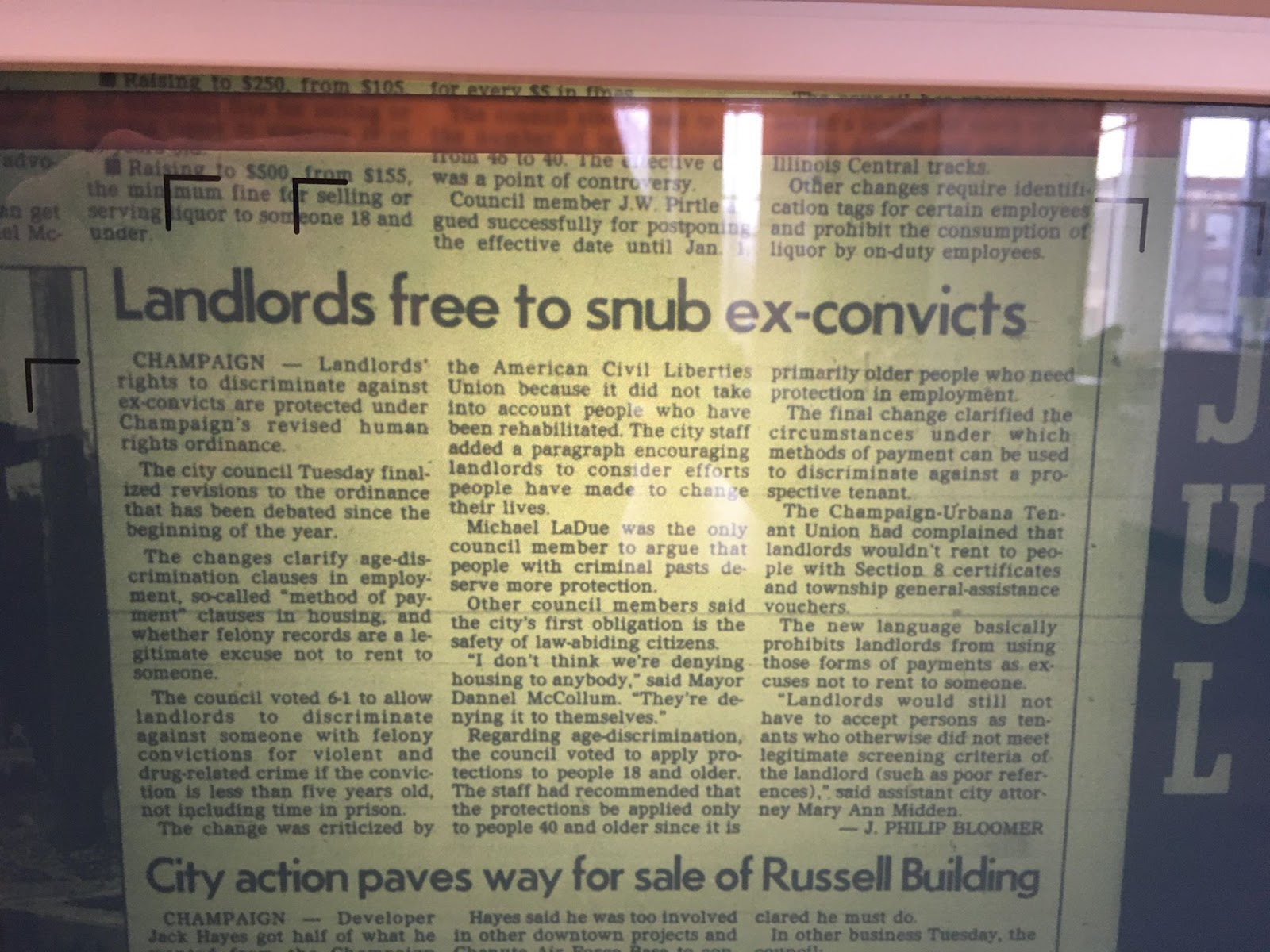
A rich versus poor angle also pops up, as wealthy criminals who can afford their own home and even be landlords themselves, are protected from discrimination on the same issue. While arguably that circumstance applies to a select few people, the proponents of ending the discriminatory language argue that's exactly the point.  An older article mentioning the original change from the broad discriminatory protections to allowing discrimination against renters on this issue seems to bear that out:


"They're denying [housing] to themselves." pretty well sums up the exact type of discrimination the original law hoped to prevent before this exception was added. Whether one agrees with the sentiment or policy, if left in place it will make it harder for people reentering their community to do so successfully and lower rates of recidivism according to the data. Even if one believes the argument they'll manage to live somewhere else as opposed to homeless and desperate, then due to the disparities in the criminal justice system it will almost certainly add to the ongoing segregation problem in the area.

No matter what side you take, or if you have ideas for a compromise that can better protect the rights of landlords and reentering community members, I encourage people to engage their City Council member and mayor to better understand the perspectives on this issue and the Champaign City Council candidates in the upcoming election.

Sunday, January 27, 2019

C-U Segregation


The following are excerpts from a recent study on segregation in downstate Illinois metropolitan areas, including the Champaign-Urbana Metropolitan area that includes a few other adjacent towns. NPR Illinois had an interview with a couple of the people behind the study here:
Would you be surprised to learn that some of the most segregated communities in the country are right here in Illinois?   Places where the problem persists, and has so for years, with little improvement.

A six month Governing Magazine investigation culiminated in a series published this week.  Reporters Dan Vock and Brian Charles culled data and tracked down numerous sources.   They crunched the the numbers and lay out some of the reasons segregation remains so prominent in towns like Springfield, Rockford, Peoria, Champaign-Urbana, Bloomington-Normal and Decatur.
Full article with links to the audio interview here. The Governing series with links to all the articles and data are here. Excerpts from the series below:


The first article of their series: Houses Divided: How States and Cities Reinforce Segregation in America
Springfield may have launched the political careers of Lincoln and Barack Obama, but it is among the worst third of American cities in terms of black-white segregation, according to our analysis of federal data. Both the Springfield and Champaign-Urbana metro areas are more segregated than that of Charlottesville, Va., or the Daphne-Fairhope-Foley area near Mobile, Ala., even though they all have similar populations and percentages of black residents...

The truth is that segregation isn’t limited to the South, or to large cities. America’s racial divide, in fact, runs right through the Heartland...

A more troubling pattern emerges when you widen the scope to look at entire metropolitan areas, focusing not just on individual cities or suburbs but looking at cities and their suburbs together. Instead of moving to different areas of the same city, whites are moving farther away to suburbs and exurbs. That’s why, measured at the metro level, progress toward more racially integrated neighborhoods over the past few decades looks decidedly less impressive. In fact, in the metro areas for Peoria, Danville and Champaign-Urbana, the degree of segregation remains roughly as high as it was in 1980...

Segregation is so stark in these communities that it’s obvious to the naked eye as you cross the roads, rivers or railroad tracks that symbolically separate white areas of town from black areas. There’s the Rock River in Rockford, University Avenue in Champaign, Main Street in Galesburg,  and the Kankakee River and a set of railroad tracks in Kankakee.


On white flight:
Increasingly, the disparities caused by racial segregation aren’t within local jurisdictions but between them. Just look at downstate Illinois schools. The core urban school districts in Bloomington, Champaign, Urbana, Springfield and Decatur -- all still predominantly white cities -- had majorities of white students in the 2002-2003 school year. Now, none of them do. Over the same period, the share of white students in Rockford Public Schools also dropped, from 48 percent to 30.

Urban districts are losing white students far faster than their metropolitan areas at large. Decatur Public Schools, for example, lost 38 percent of its white students in the last 15 years, but the rest of the metro area only lost 7 percent of its white students. By comparison, the district lost just 11 percent of its black students in the same time frame.

They highlight what they call the "biggest obstacle" to needed reforms:
People, particularly public officials, don’t like to discuss race, segregation and disparities in candid terms. They may acknowledge, in a broad sense, that their communities are divided and conditions are unequal. But politicians, especially those who represent large constituencies of white residents, prefer to talk about lifting up all neighborhoods in their jurisdictions rather than specifically correcting injustices of the past, many of them inflicted by local governments themselves.

The second article in the series: Still Separate After All These Years: How Schools Fuel White Flight
While the Peoria area stands out, school segregation across metro areas is prevalent throughout Illinois. Eight of the state’s 10 metros ranked among the highest third nationally for black-white school segregation, when considering all metro areas in the country with at least 2,000 black students. And as the Dunlap example shows, segregation in schools doesn’t just occur because of the neighborhoods they are in. The schools themselves can also be a big reason why the neighborhoods in a metro area are so segregated.

Those are among the findings of a six-month Governing investigation into segregation in Illinois. The examination focused on the metro areas of Bloomington-Normal, Champaign-Urbana, Decatur, Peoria, Rockford and Springfield -- all places outside the orbit of Chicago or St. Louis with similar-size populations in their urban cores. That investigation found that white flight and growing black populations are drastically changing the student makeup of school districts in midsize cities as well as larger ones. Just 15 years ago, the school districts in Bloomington, Champaign, Decatur, Springfield and Urbana had majority-white student bodies. Now none of them do, despite being majority-white cities...

Sociologists use a common measure called a “dissimilarity index” to assess the extent of school integration. It determines the percentage of white students who would have to attend predominantly black schools for the black-white ratio to match the black-white ratio for the area as a whole. It’s by this measure that Peoria -- when all schools across the metropolitan area are considered -- is the most segregated in the country.


On Illinois numerous school districts:
Looking at the entire metropolitan area is a way to reveal how racial segregation is occurring. Focusing on individual school districts can be helpful in some cases, but in a state with as many districts as Illinois, it can mask the severity of the problem. For example, Chicago Public Schools has twice the rate of segregation within its own boundaries as Peoria’s. Indeed, the school districts in the Peoria area generally don’t have high levels of segregation within their own borders. But that’s because the school district borders often also follow racial demarcation lines. What matters most is the disparity among neighboring districts.

Take, for example, two grade schools three blocks away from each other in the Peoria area. On the west side of Knoxville Avenue is Hines Primary School, where just over half of the students are black. Just a few blocks east is Peoria Heights Grade School, which is part of another school district and is two-thirds white.

The far-flung villages in the countryside, such as Dunlap, are booming, primarily by attracting white residents. Their schools reflect this. The Central School District in the town of Washington, on the other side of the Illinois River from Peoria, is actually growing faster than the one in Dunlap; it has more than doubled its student population in the last 15 years. The boom has brought some diversity to the school district, but not much. It has gone from 99 percent to 90 percent white.

Growth like this is especially notable at a time when many school districts are losing students. The core city districts are losing students fastest of all. The Champaign and Urbana school districts, for example, both lost a third of their white students in the last 15 years, but the rest of the metropolitan area in which they are located lost only 11 percent.

Champaign example:
The line dividing blacks from whites in Champaign, while it can be a bit porous, has been and continues to be University Avenue. Black families and black majority schools lie to the north of University, and white families and white majority schools to the south. In the 1940s, black children on the North End were sent to either the cramped Willard School or Lawhead School. White kids in the area were assigned to the all-white Columbia School. The district built a bigger facility, called Booker T. Washington Elementary School, to replace Lawhead in 1952; it became a magnet school during the 1960s in an effort to try to entice white students to the North End. By and large, though, the district remained divided by geography and race.
The article goes on to explain the attempts at desegregation, the legal set backs, and a current reality where schools are becoming more segregated again.


The third article in the series explains some of the historical roots of segregation and how they're maintained or even worsened by modern policies that enshrine the outcomes of the past using colorblind terminology: Broken Homes: How Housing Policies Keep White Neighborhoods So White (and Black Neighborhoods So Black)
It has deep roots in racial animus, going back to the days of redlining and racially restrictive covenants. The aftereffects of those policies linger on in the 21st century.

Today, the stated motivation for the existing arrangement is not race, but money. It’s why homeowners protest public housing projects or apartment buildings that could bring down their property values. It’s why subdivision developers sell homes with strings attached that keep neighborhoods homogeneous and unaffordable to lower-income residents. And it’s why Hightower’s rent, and the federal subsidies it generates, improve the bottom line for a multinational company headed by the owner of the Miami Dolphins.

Regardless of the motivation, the effect is largely the same: Cities and, indeed, entire metropolitan areas, remain largely segregated along racial lines...

Local governments help create those divides in several ways, but one of the most important is by regulating land use, especially residential development. The regulations include zoning restrictions, housing subsidies, tax incentives, public housing policy and restrictive covenants. None of them are necessarily discriminatory by themselves, but the way they are routinely used combines to create that effect.

“At the bottom of all that is that are whites trying to preserve opportunities for themselves,” says Domenico “Mimmo” Parisi, a sociology professor at Mississippi State University and the executive director of the National Strategic Planning and Analysis Research Center.

The fourth article in the series looks at the differences in policing and criminal justice outcomes that further reinforced disparities in housing, employment, and education: Black, White and Blue: How Police and Anti-Crime Measures Reinforce Segregation
RHA had hired the private security firm, Metro Enforcement, to police its properties. Together, the agency and Metro had taken a hard line on enforcement. Small infractions, such as not having ID, could lead to expulsion from RHA property. In 2012, when Clewer became CEO, hundreds of people a year were being kicked out for trespassing. More often than not, that merely meant the offenders had failed to carry or show identification to a security officer. Being banned from one unit could disqualify them for Section 8 housing assistance vouchers, which the housing authority also administered.

A low-level offense could quickly escalate, as it had in the son’s case. Because the security guards were hired by the RHA to monitor its own property, they didn’t have to operate under the same strict rules police officers do. So, for example, they could search a 15-year-old without probable cause and, when they discovered a joint, turn him over to the Rockford Police Department. When Clewer began looking at data on arrests at RHA properties, he found that 80 percent of them were linked to the RHA’s bans. “We weren’t providing safety,” Clewer says now. “We were providing military control.”

The intense scrutiny of the residents at the Rockford Housing Authority is common in areas where poor black people live. Heavy-handed enforcement tactics are often employed in the name of protecting residents from crime. But often they catch only low-level offenders, with dire consequences for the offender’s ability to get a job or decent housing. That, in turn, reinforces deep-seated patterns of segregation in the communities where zero tolerance policies are used...

Our review found many practices that placed greater burdens on black residents than white residents because of where they lived. These practices were used not just by police, but by non- law enforcement agencies like the Rockford Housing Authority. They included increased surveillance, frequent ID checks and rigorously enforced nuisance ordinances. 

All of the articles, data, methodology, etc are available at the series' main webpage here. More Cheat Sheet posts on racial disparities in Champaign-Urbana include Pedestrian and Traffic Stop Data, School Punishment Data, "Pushout" in Unit 4 schools, and the Reentry Housing Issue in Champaign.

Friday, January 11, 2019

Shutdown Local Effects


Various local and county services are facing delays, closures and complications due to the partial federal shutdown. Here's a few examples from the local and county level:

Local farmers are facing various challenges and delays from trade-war bailout applications to commodities pricing. From the News-Gazette Wednesday:
Farmers get more time to apply for bailout funds
...
Champaign County Farm Bureau Manager Brad Uken said closing the local FSA offices is "kind of a big deal."

"A number of programs that are initiated at the federal level are then implemented at the local level through that office," he said. "When they're closed, they don't get implemented or administered."

He said that has affected the trade payments and the processing of farm loans for the coming year.

The local USDA offices in west Champaign have been half closed and half open.

The FSA and Rural Development are closed, but the Natural Resources Conservation Service, which has its state headquarters in Champaign, is open, state spokeswoman Paige Buck said...

Farmers have also been indirectly impacted by the absence of reports from the National Agricultural Statistics Service, which drive commodity markets and help growers decide what to grow and when to sell their crop...

The NASS has already said a slew of reports scheduled to come out Friday will be delayed, even if the shutdown ends before then.
Full article with more information here. Research dependent on federal funds and agencies has also been affected. From Tuesday's News-Gazette:
For federal researcher, government shutdown impedes office, maternity planning
...
LeRoy is a hydrologist at the U.S. Geological Survey's Central Midwest Water Science Center at 405 N. Goodwin Ave., U, where 40 to 50 full-time employees have been furloughed because of the shutdown...

Employees are allowed to check email for a short time once a day, she said.

They've received one partial paycheck since Dec. 21 that included work done before the shutdown. LeRoy isn't sure what will happen with the next one and said they haven't gotten any word about potential back pay...

Meanwhile, at the UI, more than 30 federal employees of the U.S. Department of Agriculture's Agricultural Research service have been directly affected by the shutdown, according to Professor Adam Davis, head of the Department of Crop Sciences.

Davis said last week that at least nine USDA researchers who are affiliated UI professors were furloughed. But with all scientists and support staff members included, the number totals 31, Davis said Monday.

"This indirectly, and negatively, affects dozens of UIUC graduate students and post-docs who conduct research in these labs," he said.
Full article with more information here. This article was following up on another that highlighted the mixed bag of effects on the University, with some mitigated by the partial nature of the shutdown. The longer the shutdown drags on the more complicated and problematic it becomes, however:
UI mostly unaffected by government shutdown — for now
...
Students can still get loans and fill out their Free Application for Federal Student Aid as usual, although they could see a delay if extra documentation is needed from the Internal Revenue Service, said Dan Mann, UI associate provost for enrollment management...

The bigger issue is research funding, especially if the shutdown drags on.  Among the science agencies affected are NASA, the National Science Foundation, National Oceanic and Atmospheric Administration, National Institute of Standards and Technology, U.S. Geological Survey, and Environmental Protection Agency...

Money for current research grants has already been disbursed, but the authority to spend it could be affected if the shutdown lasts more than 30 days, said Bill Gropp, director of the National Center for Supercomputing Applications...

Davis said the larger worry is the potential delay in submitting, and reviewing, new research proposals. Federal granting agencies typically post new requests for proposals for new research opportunities at this time of year, but many are now closed, Davis said.

If the shutdown lasts for a month or more, "it may cause an issue with the next round of grant competition," agreed Evan DeLucia, director of the Institute for Sustainability, Energy and Environment, which works closely with the recently furloughed agricultural researchers.
Full article here. Various State and local social programs could face interruptions and complications as well. The proposed reentry transitional housing program mentioned in a post earlier this week is also facing possible delays due to the shutdown's effect on the department of Housing and Urban Development, which oversees the Housing Authority of Champaign County.

These are just a few examples and this is certainly not an exhaustive list. One thing you learn very quickly following local government is how intertwined local programs can be on multiple sources of funding, including federal grants and agencies. The Illinois' State budget impasse or a federal government shutdown aren't just some furloughed bureaucrats in Washington D.C. It people losing medical care, kids going without food, access and opportunities in education lost, homes lost, and lives threatened. They're your neighbors and fellow citizens right here in your community.

Sunday, October 7, 2018

Urbana Council and Union Gardens


Last week the Union Gardens vote was delayed until the October 15th Urbana City Council meeting. From last Tuesday's News-Gazette:
Urbana council delays vote on Union Gardens development
The city council on Monday rescheduled a vote that would advance the Union Gardens development slated for an area straddling the Champaign-Urbana city line in the northern part of the cities.

At the request of the developer, West Lafayette, Ind.-based Trinitas Ventures, the council is now set to vote on annexation and rezoning ordinances for the 406-unit housing development on Oct. 15.

Because it bisects the city line, Union Gardens must be approved by both cities, with Urbana annexing some land from the county and rezoning its section of the proposed site — about a third of the total plot — for housing development.

Terry Townsend, former vice chairman of the Housing Authority of Champaign County, called for a town hall to be scheduled between now and the Oct. 15 vote to talk about affordable housing. He also called for the council to vote down the proposal.
More at the full article here, including an additional bit of information on passed body camera funding for the Urbana Police Department here. More information on the Union Gardens proposal, including criticisms, are in a previous article here.

Friday, July 27, 2018

Champaign City Council Housing Ordinance


On Tuesday the Champaign City Council heard from numerous local activists, organizations, and directly impacted citizens about repealing the exemption for housing discrimination protections for certain convicted felons. Various realtors, mainly in favor of keeping the exemption, also came out and made their case. Video is available here and a write up is below. The housing issue began with Public Participation for those who want to skip straight to that.


Meeting Notes (agenda here):

The meeting kicked off with the mayor inducting two firefighters by oath to positions in the City of Champaign.

There was a "public hearing" for the Stormwater Quality Program to allow public input to the council, but no one from the public took the opportunity to speak.

The council moved forward on a Honorary Street Name request for Robert Grossman, although as I understand there still needs to be final approval in a regular city council meeting. The applicant for the request spoke in support and stated his appreciation for the consideration and highlighted Mr. Grossman's charitable work.

There was a presentation and overview of the Snow and Ice Control Plan by Public Works Director Dennis Schmidt and Supervisor Brock Summers, a 20 year veteran of Public Works. In general the plan is essentially the same as what has been in effect for over a decade. A priority is put on the main thoroughfares first and on down to cul-de-sacs and dead end streets. Council members brought up concerns raised by their constituents about equality as some residents feel left behind waiting for their streets to be cleared.

The director highlighted that eight of the last ten budgets went over budget, and the other two were simply one storm away from going over budget as well. He asked for a more realistic budget ahead of time rather than current trend of underestimating the need. Mayor Feinen made her annual plea for individuals and businesses to uphold their obligations for snow shoveling and helping neighbors who may need assistance.

The council discussed changes to the yard waste program, including spring collection dates and expanding it back to all residential properties again.


Public Participation and Housing:

Groups supporting the reform included First Followers, the ACLU, the Champaign County Reentry Council, the NAACP, the City of Champaign Human Relations Commission, CU Indivisible, a Mennonite Church, and the C-U Tenant Union. Several individuals, some with felony convictions in their past, also argued the supporting arguments and data that access to housing helps lower recidivism and aids opportunity for rehabilitation.

A couple landlords argued in favor of the change. It was pointed out that the restriction on low income tenants does not apply to homeowners or landlords who may have been convicted of the same crimes.

The realtors overall stayed on a very focused message at each opportunity to speak. They want to protect their right to ask questions and ensure the safety of their residents. They framed changing the ordinance back to the original and in line with Urbana as discrimination against realtors and their property rights. They highlighted the scariest scenarios and most dismal anecdotes as inevitable, as if they'd be powerless to screen tenants without being able to discriminate solely on history of criminal conviction.

The speakers speaking for larger realtor groups kept close to that framing with as much deference to the hard work and empathy with speakers on the other side who work with reentry and have gone through reentry themselves. A couple more frustrated people made sure to make digs at "the criminals" daring to criticize their town.

The pro-reform arguments pointed to the vast racial disparities in the criminal justice system outcomes, even for the same crimes, as why they shouldn't be relied on to further racial discrimination in housing. Landlords refused to acknowledge the connection and or outright put that responsibility on the state even if they use those outcomes.

The landlords generally argued for their own discretion and painted a picture of Champaign area landlords as overwhelmingly being beyond racism and going out of their way to give rehabilitated felons a chance with extra scrutiny. Organizations and impacted tenants pointed to statistics and personal stories of hardship as they struggle to avoid discrimination in Champaign versus other area locations.


Board Comments:

Overall the board seemed to appreciate the civility and and level heads of everybody who came out to argue on both sides of the issue. There seemed to be interest in at least having a study session to look at the data and discuss possible compromise language as opposed to just a flat out repeal of the language.

Council member Fourman made a personal argument about the need to ensure the safety of residents and her constituents. She argued that it's premature to have a study session and doing so will give people the impression the council is ready to begin implementation when it's not. She pointed to other solutions to address aiding employment, reentry programs, etc. "How do you know you're helping people be safe? I'm asking you?" She pointed out that what she regularly hears from her constituents is frustration that the City isn't helping get the bad actors out of their neighborhoods, from drug dealers to dangerous criminals.

There was some back and forth between Fourman and Beck (even as the Mayor reiterated that the comment opportunity wasn't for such back and forth discussion). There was a disagreement on what was said before, where, and Fourman complained that Beck interrupted her as an example of the problem with her communication. "You won't let me finish talking."

Gladney and Kyles talked in favor of having the conversation, though wanted to learn more before taking a stance on any particular changes, if any.

Stock and Brix viewed compromise as the way forward and described taking the language back to the original as an "absolute." Perhaps it was just my impression as someone with an opinion on the subject, but it seemed like they didn't like the choice being described as whether the City would be allowing discrimination or not. They say the trick to compromise isn't making everyone happy, but getting enough unhappy people on board. I suppose we'll see how that works out in the future.

The Mayor also reiterated the appreciation for the overall respect and civility by everyone and pointed to this meeting as an example of local government at its best when it can hear from well meaning people on both sides of an important issue. She pointed out that unlike many contentious issues, the people getting up to speak were all mixed together instead of on one side of the room or the other.

The meeting adjourned at 10:14pm with a reminder that next week is the 5th Tuesday of the month and there's no City Council meeting scheduled (for those who attend regularly on the 1st through 4th Tuesday regular/study session meetings.).

Sunday, July 22, 2018

Reentry Housing Issue

For some background, CU Indivisible has laid out an overview of the issue which I've shared in a Cheat Sheet post here. More on the Racial Justice Task Force recommendations here.From the News-Gazette today:
For felons, Champaign's housing code a hindrance
When a person returns to society after prison, the clock immediately starts ticking.

To reintegrate back into civilian life, most journeys start with finding sustainable employment and housing. Time is of the essence as each post-release day and week goes by.

The longer one goes without employment or housing could heighten their chances of falling back into the criminal justice system. Once a month has passed, James Kilgore argues, a person's future is likely determined.

"Some people even talk about the first week being the most critical," the former Symbionese Liberation Army activist said about his own recovery after spending 6 years in a California prison. "It's real easy to lapse into depression or self-medication — a downward spiral."

As co-director of the First Followers re-entry program, Kilgore navigates people through the stark changes that life after prison can bring. He's also part of a push to modify the portion of Champaign's city code that allows for housing discrimination against certain former inmates.

Chapter 17 of the code concerns human rights, and section 17-4.5 was added in 1994 to allow "discrimination in the leasing of residential property based upon a person's record of convictions for a forcible felony or a felony drug conviction or the conviction of the sale, manufacture or distribution of illegal drugs," up to five years after release.

Despite that, the section states that it shouldn't be used to discriminate on the basis of race, ethnicity, disability and other protected categories.
More at the full article here. The key problem with the current language is that it pretends that the results of our criminal justice system haven't already built discrimination into their results. As we've found out time and time again on the national and local level. For example, from a recent RJTF presentation to the County Board (direct video link here):
There was a presentation by Ryan Huges and Doctor Carolyn Randolph from the Racial Justice Task Force advocating for the Community Engagement recommendations to be adopted. They discusses a project (more information here and database here) in coordination with Dr. Bev Wilson and U of I students collecting and analyzing criminal justice statistics in the area from the County Sheriff's department, Jail, Circuit Clerk, and four other police departments. One example they noted was that controlling for age, sex, and type of crime across five departments, Africian-Americans were still four times more likely to go to jail than white suspects.
And it starts early. Unit 4 is already trying to address "pushout" that criminalizes young black women (more on that in a Cheat Sheet post here). The school to prison pipeline isn't some concept foreign to Champaign-Urbana here. Local school disciplinary data shows racial disparities in local school districts and individual schools right here in Champaign County: Education Racial Disparity Data. At every step of the way from police contact, to bail, to legal counsel, prosecution, sentencing, and reentry,... many minorities experience the same justice system differently than whites. Racial disparity rears its ugly head even while controlling for factors other than race.

It is dangerous and unnecessary to throw our hands up in the air and take no responsibility for the discrimination with a law that directly perpetuates it. We can't willfully ignore the other problems and not become complicit in them.

The counter-argument given in this article turns the whole issue on its head. They make it sound like they could no longer screen problematic tenants, which is bass-ackwards. It would require them to actually screen for problematic tenants in order to deny them housing and not just assume all convicts are problematic tenants. There are plenty of completely legal and valid reasons for landlords not to rent to someone with or without a criminal conviction. All of the safety concerns of victims and limits on predators are still there.

The scare tactics are unfortunate given that this language was originally changed without any of the nightmare scenarios being the driving force. In fact, it was exactly what you'd expect it to be... they brought it on themselves. There was zero-regard for inequities in the system or any expectation of rehabilitation or redemption. The message was clear (click to enlarge):


As our community has tried to improve on race and equity, this language remains an anachronistic stain on our community. HUD and the Housing Authority have documented the need for better housing access nationally and laid out why they're also starting to end such restrictions. They perpetuate discrimination and increase recidivism (HUD guidance here).

It's worth noting that this applies only to renters. A wealthy fellow who pleads out to the same felony can still buy a house right next door. It would be illegal to discriminate against him for that conviction. He could rent it out. He could legally discriminate against tenants in the same situation. He could be your landlord. That says it all really.

Monday, July 9, 2018

Urbana Disability Housing and Police Contract

UPDATE: The disability housing agreement and police contract was approved by the Urbana City Council at the meeting previewed below. More on that from the News-Gazette yesterday: Urbana council gives initial OK to plan to create housing for disabled]


The Housing Authority of Champaign County (Cheat Sheet post on HACC here) and Urbana are working together on a housing collaboration for residents with disabilities and financial constraints. In today's News-Gazette article it highlights some of the county organizations that work with local governments and in concert with federal and other programs:
Housing for disabled may get boost from grant, other funds
...
The Urbana City Council will vote tonight on entering into an intergovernmental agreement with the Housing Authority of Champaign County. If approved, the HACC will apply for funding — from the Illinois Housing Development Authority — to create up to 24 units of permanent supportive housing.

Cunningham Township supervisor and HACC board member Danielle Chynoweth said the subsidized units, slated for 1606 E. Colorado Ave., would be targeted to single people from vulnerable populations who have mental or physical disabilities...

Chynoweth said local recipients of Supplemental Security Income or Social Security Disability Insurance are rent burdened, by federal standards, if they pay more than $250 a month.

"Even a tiny room in a boarding house is typically $450 and up," Chynoweth said. "I brought the grant opportunity to the HACC because we have extremely insufficient housing for people with disabilities."

There are three organizations in Champaign County that award permanent supportive housing rental vouchers, according to data from the Champaign County Regional Planning Commission. They are Rosecrance, the HACC and the CCRPC.

Urbana wouldn't contribute financially to the tax-exempt housing, according to a city staff report. Instead, a combination of the grant, HACC funding and private funding would be used.
More information at the full article here. If you missed some of the drama about Chynoweth being seated on the HACC board of commissioners, here's a quick Cheat Sheet post with links to catch you up: Chynoweth Cleared by HUD for HACC. The News-Gazette also had a blurb up on their website last night on the Urbana Police contract being voted on tonight:
Urbana council set to vote on new contract with police officers
The city council is set to vote on a new three-year contract with police officers that includes raises.

Under the terms of the new agreement, which is retroactive to July 2017 and runs until July 2020, all union police officers would see a 2 percent pay increase in each year, with sergeants getting an additional $1,000 each year.

The contract also broadens the rules related to time off for the death of a loved one and mandates that if an officer trades a shift with another but can't work the new shift due to illness or injury, they will be docked sick time.